 |
Motor de Búsqueda de Datasheet de Componentes Electrónicos |
|
|
Motor de Búsqueda de Datasheet de Componentes Electrónicos |
|
The question interval is too short.
Please try again in a few seconds.

Hello, Please ask a question about AS1123 Datasheet
# Example questions:
➢ What is the minimum operating frequency of the serial interface for the as1123, and what is its relevance to high-volume data transmission?
➢ What signal is used to latch data from the shift register into the data register?
➢ What is the typical operating temperature range for the as1123, as stated in the 'typical operating characteristics' section?
| Part No. | AS1123 |
| Manufacturer | AMSCO |
| Size | 2Mb |
| Pages | 25 pages |
| Description | Constant -Cur rent , 16 -Channe l LED Dr iver wi th Diagnost ics |









1. Overview & Functionality
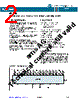
️· Purpose: The AS1123 is a constant-current LED driver. It's designed for driving up to 16 LEDs through a serial interface. It also includes diagnostics for open/shorted LEDs and over-temperature detection.
️· Application: Suitable for LED traffic sign applications.
️· Current Control: External resistor (REXT) allows adjustment of LED current from 0.5mA to 40mA.
️· Serial Interface: Uses SDI (Serial Data In) and SDO (Serial Data Out) pins. Operates at a minimum of 30 MHz.
️· Data Handling: Employs a 16-bit shift register and a 16-bit data register to convert serial input to parallel output.
️· Multiplexing: Pins SDO, LD (Latch Data), and OEN (Output Enable) are multiplexed for additional functionality.
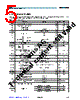
2. Electrical Characteristics (Limited – incomplete excerpt)
️· Maximum Output Voltage: 5.5V at the outputs. The full datasheet would contain more specific voltage and current limits.
️· Current Range: 0.5mA to 40mA (adjustable with external resistor).
3. Timing Characteristics
️· Data Input:
- Serial data is shifted in on SDI on each rising edge of the clock (CLK).
- Data is latched into the data register on each rising edge of LD.
️· Output Enable (OEN):
- OEN going low enables the LED drivers.
- OEN going high disables the LED drivers.
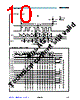
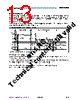
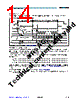
️· Key Timing Parameters (Refer to Figures 3, 4, 5, 9, 10, 11 & 12 – incomplete excerpts, but provide the following concepts):
- tSU(L): Setup time for LD.
- tH(L): Hold time for LD.
- tW(L): Pulse width of LD.
- tW(CLK): Pulse width of CLK.
- tP1: Time associated with the data latching
- tH(D): Hold time data
- tSU(D): Setup time data
- tW(OE): Pulse width of OEN.
- tP3: Associated with the output stage and response.
- tOR/tOF: Fall/Rise times associated with outputs.
- tREXT2,1: External resistor reaction time (change in current).
4. Features & Operation
️· Diagnostics: Includes diagnostics for:
- Open- or shorted-LEDs.
- Over-temperature conditions.
️· Low-Current Diagnostic Mode: Allows testing for open/shorted LEDs and over-temperature.
️· Serial Communication: Data transmission at a rate of at least 30 MHz.
️· Data Input Example Timing: Diagram illustrates the sequence of data input and latching.
️· External Resistor Reaction Time: Change in current response time.
️· Cascading: Can be cascaded, timing considerations are important.
Cut-off or Incomplete Information:
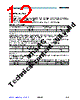
️· Electrical Characteristics: The full list of electrical characteristics is missing.
️· Detailed Descriptions of Diagnostics: The exact mechanisms for open/shorted LED and over-temperature detection aren't fully explained.
️· Pin Descriptions: A complete listing and description of all pins is absent.
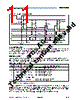
️· Block Diagram Explanation: The block diagram needs more explanation regarding the functionalities of the various blocks.
️· Timing Diagram Captions and Clarifications: Several timing diagrams are incomplete or lack detailed captions, making it difficult to fully understand their meaning.
1. Overview & Functionality
️· Purpose: The AS1123 is a constant-current LED driver. It's designed for driving up to 16 LEDs through a serial interface. It also includes diagnostics for open/shorted LEDs and over-temperature detection.
️· Application: Suitable for LED traffic sign applications.
️· Current Control: External resistor (REXT) allows adjustment of LED current from 0.5mA to 40mA.
️· Serial Interface: Uses SDI (Serial Data In) and SDO (Serial Data Out) pins. Operates at a minimum of 30 MHz.
️· Data Handling: Employs a 16-bit shift register and a 16-bit data register to convert serial input to parallel output.
️· Multiplexing: Pins SDO, LD (Latch Data), and OEN (Output Enable) are multiplexed for additional functionality.
2. Electrical Characteristics (Limited – incomplete excerpt)
️· Maximum Output Voltage: 5.5V at the outputs. The full datasheet would contain more specific voltage and current limits.
️· Current Range: 0.5mA to 40mA (adjustable with external resistor).
3. Timing Characteristics
️· Data Input:
- Serial data is shifted in on SDI on each rising edge of the clock (CLK).
- Data is latched into the data register on each rising edge of LD.
️· Output Enable (OEN):
- OEN going low enables the LED drivers.
- OEN going high disables the LED drivers.
️· Key Timing Parameters (Refer to Figures 3, 4, 5, 9, 10, 11 & 12 – incomplete excerpts, but provide the following concepts):
- tSU(L): Setup time for LD.
- tH(L): Hold time for LD.
- tW(L): Pulse width of LD.
- tW(CLK): Pulse width of CLK.
- tP1: Time associated with the data latching
- tH(D): Hold time data
- tSU(D): Setup time data
- tW(OE): Pulse width of OEN.
- tP3: Associated with the output stage and response.
- tOR/tOF: Fall/Rise times associated with outputs.
- tREXT2,1: External resistor reaction time (change in current).
4. Features & Operation
️· Diagnostics: Includes diagnostics for:
- Open- or shorted-LEDs.
- Over-temperature conditions.
️· Low-Current Diagnostic Mode: Allows testing for open/shorted LEDs and over-temperature.
️· Serial Communication: Data transmission at a rate of at least 30 MHz.
️· Data Input Example Timing: Diagram illustrates the sequence of data input and latching.
️· External Resistor Reaction Time: Change in current response time.
️· Cascading: Can be cascaded, timing considerations are important.
Cut-off or Incomplete Information:
️· Electrical Characteristics: The full list of electrical characteristics is missing.
️· Detailed Descriptions of Diagnostics: The exact mechanisms for open/shorted LED and over-temperature detection aren't fully explained.
️· Pin Descriptions: A complete listing and description of all pins is absent.
️· Block Diagram Explanation: The block diagram needs more explanation regarding the functionalities of the various blocks.
️· Timing Diagram Captions and Clarifications: Several timing diagrams are incomplete or lack detailed captions, making it difficult to fully understand their meaning.
| Part No. | AS1123 |
| Manufacturer | AMSCO |
| Size | 2Mb |
| Pages | 25 pages |
| Description | Constant -Cur rent , 16 -Channe l LED Dr iver wi th Diagnost ics |
| ¿ALLDATASHEET es útil para Ud.? [ DONATE ] |
Todo acerca de Alldatasheet | Publicidad | Contáctenos | Política de Privacidad | Enlace a la hoja de datos | Intercambio de Enlaces | Lista de Fabricantes All Rights Reserved©Alldatasheet.com |
| Russian : Alldatasheetru.com | Korean : Alldatasheet.co.kr | Spanish : Alldatasheet.es | French : Alldatasheet.fr | Italian : Alldatasheetit.com Portuguese : Alldatasheetpt.com | Polish : Alldatasheet.pl | Vietnamese : Alldatasheet.vn Indian : Alldatasheet.in | Mexican : Alldatasheet.com.mx | British : Alldatasheet.co.uk | New Zealand : Alldatasheet.co.nz |
|
Family Site : ic2ic.com |
icmetro.com |
 Spanish ▼
  English
 Chinese
 German
 Japanese
 Russian
 Korean
 French
 Italian
 Portuguese
 Polish
 Vietnamese
 Indian
 Mexican
 British
 New Zealand